The FUNdamentals of Flash Fiction
Sophia Hansen
Flash Fiction FUNdamentals
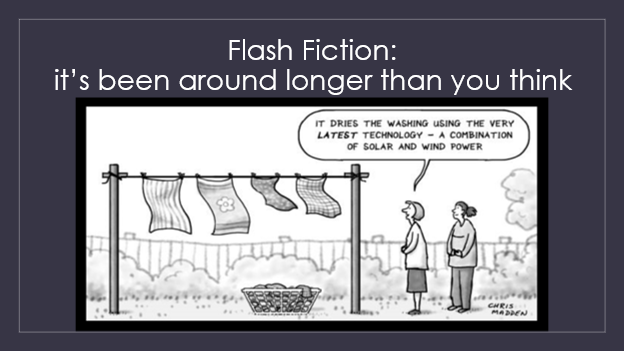
Flash fiction may sound new and alien, but it’s been around longer than you think.
“How short can a short story be and still be a short story?”
In 1916, this query inspired the first flash fiction contest. Short Stories From Life featured 81 stories from the Shortest Story Contest.
Further questions raised as the project grew were: When is a story not a story, but only an anecdote?
When a story is a story, is it a combination of plot, character, and setting, or is it determined by only one of these three elements?
Must it end when you have ended it or must it suggest something beyond the reading?
These are still some of the questions asked about flash fiction, but let’s clarify.
WHAT IS FLASH FICTION?
Flash Fiction is a form of short story, usually between 300 and 1,000 words.
It must be complete in itself—a full narrative arc, containing a struggle of some sort between two opposing forces.
There needs to be a goal with real consequence.
WHY WRITE FLASH FICTION?
You get to play with a new story!
It’s a good way to push past writer’s block—and writing prompts are a fun way to jumpstart creative juices.
You’ll get used to editor redlines (aka Track Changes) and publisher deadlines.
You’ll experience the rush of finishing!
You’ll learn to write and edit tighter.
You’ll create content (aka lead magnets) to offer your readers.
You can be published faster.
Getting published in flash fiction is not automatic, but the barrier to entry is not as steep as it is for a full-length novel.
HOW TO WRITE FLASH FICTION.
Getting down to business
Every story needs a beginning, a middle, and an end whether it’s spread over a seven-book series or a 50-word fiction. You need a beginning that will hook the reader, a middle that engages them, and a satisfying ending. And you need to do that in 1,000 words.
Basic Structure for Plotters
For plotters, here’s a basic structure for a 1,000-word flash fiction story. I’m pretty committed to pantsing—but people who plot say this structure is helpful.
Intro: ~ 150 words to introduce the setting and characters. If you can, start in the middle of the crisis and imply previous try-fails (see the example in Brownie Points)
Rising action: ~ 600 words to develop the main conflict (continued try-fails, conflict/crisis)
Climax: ~ 200 words to share the turning point/most intense moment.
Resolution: ~ 50 words to reveal a satisfying ending or twist.
Beginnings
Pay attention to submission requirements.
Make your title earn its keep! It’s not included in your word count, so use it to set the stage or foreshadow a twist.
Your first line needs to hook the reader.
Keep a thought of the end in the beginning
Pay attention to POV and voice (whether you choose 1st, 2nd, or 3rd)
Limit your characters to one or two–but include the conflict of two opposing forces
Introduce the setting. Let us feel your world. Use your senses. When you introduce a feature, make sure it’s pertinent to the plot
Avoid over-exposition - RUE
Writing prompts are a fun way to get started.
Check out upcoming themes for contests (Havok, Spark, NYC Midnight)
Reedsyprompts https://blog.reedsy.com/creative-writing-prompts/
Story Dice
Here are some of my favorite openings:
“There are things they don’t tell you about having green skin.”
Photosynthetic by Cassandra Hamm
“Buzzing speakers scrape at my nerves as decrepit shocks collide with Boston’s finest potholes. The cab barrels down Newbury Street. He’s not stopping. He’s not even slowing down.”
Trumpet Blues by Sophia Hansen
“I did not have a name—none of us did—but once when I was young, I had a friend.”
RECORDER by Cathy McCrumb
Middles
The story doesn’t start until something goes wrong - Steven James
Dialogue, dialogue, dialogue
Action beats can reveal more about your characters than dialogue tags.
Reveal, don’t lecture (aka show, don’t tell)
What are the stakes? What happens if the MC fails? Will the reader care?
Imply previous try/fail cycles. “This time…”
Avoid talking heads—use the whole body to communicate your character’s state of being—shoulders, fingers, knees, toes. What are the tells, the subtext?
Another Favorite Opening from Brownie Points by Lavender Ellington:
Commander Tri’eek’s ship was self-destructing.
Bianca muttered Earth English curses under her breath as she ran through the Argo’s gigantic ventilation shafts, holding a gargantuan stolen ring of shiny, black electrical tape around her waist like a life ring. She had spent three precious hours tracing the problem to the engine maintenance room. She couldn’t afford to be wrong.
End
Foreshadowing: Your readers want to know what’s going to happen but they also want to be surprised—so plant seeds of the ending in the beginning and throughout the story.
Mirroring: An ending that reflects the beginning brings a full-circle satisfying sense of closure.
Your ending needs to be satisfying and the conflict, resolved—whether it’s positive or negative. Leave your readers with a thought to chew on, a twist, or an aha moment. Does the story convey an idea larger than itself?
N.B., in Short Stories From Life, gives the reader serious pause with their twist ending, as does the Sci-Fi classic, To Serve Man.
Finishing:
Check for repeated words or concepts, unnecessary details, or cliches.
Look out for repeated pronoun-verb openings.
Read it out loud and get someone else to look at it.
Recheck the submission requirements before hitting SEND!
Where to submit:
Havok Publishing wants stories that hit fast and strike hard––stories that can cut through the day’s troubles and grip distracted readers. They also provide feedback on all submissions, unless requested otherwise.
Spark Flash Fiction looks for romance stories that will grab the reader and put a spark in their day.
NYC Midnight hosts contests for a variety of short fiction stories. For a small entry fee they provide prompt-based challenges, feedback from their judges, and peer feedback forums.
https://internationalwriterscollective.com/great-places-to-submit-flash-fiction/
REEDSYPROMPTS has weekly writing prompts. Check out their FAQ for details.
Resources:
Brandon Sanderson: SHORT STORIES with Guest lecturer Mary Robinette Kowal
https://www.youtube.com/watch?v=blehVIDyuXkGrant Faulkner The Art of Brevity
https://grantfaulkner.com/books/the-art-of-brevity/
https://youtu.be/K3VhXltVTtc?si=Lfxirn5oRzO8kmgm
Community
Facebook
Flash Fiction Writers Guild
Flash Fiction Lovers
Instagram
Search #gohavok
Finally:
If you’re curious about flash fiction, read it!
There are plenty of free sources and they don’t take more than a few minutes of your time.
Consider volunteering at HAVOK—you get on-the-job training and support.
https://gohavok.com/
N. B.
By Joseph Hall
Lieutenant Ludwig Kreusler glanced hurriedly through the mail that had accumulated during the month that the X-8 had been away from base. At the bottom of the pile he found the letter he had been seeking and his eyes brightened. It was a fat letter, addressed in feminine handwriting, and its original postmark was Washington, D. C., U. S. A.
“His Excellency will see you, sir.” The orderly had entered quietly and stood at attention.
With a slightly impatient shrug the Lieutenant shoved the letters into his pocket and left the room.
He found Admiral Von Herpitz, the wizard of the sea, at his desk. As the young man entered the old Admiral rose and came forward. This unusual mark of favour somewhat embarrassed the young officer until the old man, placing both huge hands upon his shoulders, looked into his eyes.
“Excellent.”
The one word conveyed a volume of praise, gratification. The old sea dog was known as a silent man. Censure was more frequent from him than applause.
The Lieutenant could find no word. The situation was for him embarrassing in the extreme. He, like Herpitz, was a man of actions, and words confused him.
“These English,” the old Admiral spoke grimly, “we will teach them. Have you seen the reports? They are having quite a little panic in America also over the Seronica. Two hundred of the passengers lost were American.”
A file of papers lay on the table. Kreusler ran through them hurriedly. The Berlin journals gave the sinking of the Seronica great headlines followed by columns of sheer joy. The London and Paris and some of the New York sheets called the exploit a crime and its perpetrators pirates. But they all gave it utter and undivided thought. The X-8 had become the horror craft of the world. Berlin figuratively carried her young commander on her shoulders. He found himself the hero of the hour.
“You have done well for the Fatherland,” Von Herpitz repeated as the Lieutenant was going out.
In his own cabin Kreusler forgot the Seronica and the X-8. The fat letter with the Washington postmark absorbed him.
Two years, ending with the outbreak of the great war, Kreusler had been naval attaché to the German embassy at Washington. He had been popular in the society of the American capital. He was highly educated, a profound scientist, an original thinker, and an adaptable and interesting dinner guest. Dorothy Washburn, the youngest daughter of the Senator from Oregon, had made her début in Washington during the second winter of Kreusler’s presence there. The two had met. They were exact opposites; he tall, severe, blond, thoughtfully serious; she, small, dark, vivacious, bubbling with the joy of life. Love was inevitable.
The fat letter was engrossing. It breathed in every line and word and syllable the fine love this wonder woman gave him. One paragraph was most astounding. It read:
“To be near thee, loved one, I have arranged, through the gracious kindness of our friends, to come to Berlin as a nurse. Just when is as yet uncertain, but come I will, fear not, as quickly as may be. Dost long for me, to see me, dearest heart, as I for thee? Well, soon perhaps that may not be so far away. Couldst not thou arrange to be wounded—only slightly, of course, my love—so that I might attend thee?”
The letter ended with tender love messages and assurances of devotion. The last sheet bore a single word, “Over,” and on the reverse side a woman’s most important news, a postscript. This read:
“P. S. Arrangements have been completed. Everything is settled. Even my father has consented, knowing of my great love. I sail next week.”
And then:
“N. B. The ship on which I sail is the Seronica.”